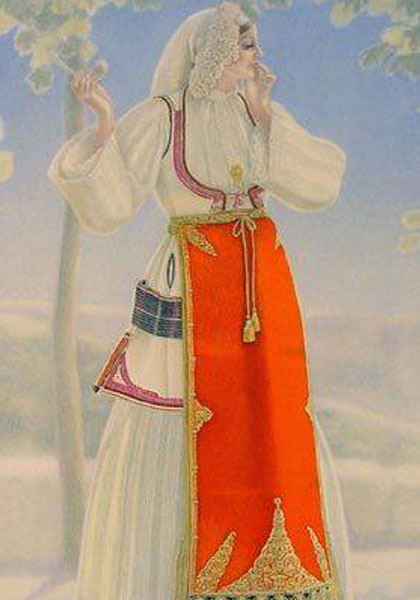
The costume belongs typologically in the costumes with kavadi. The main garment is "jerkin" or "zoupounas", which was established as a terminology for the entire costume.
A blog dedicated to the revival of our history through the regional costumes of Greece, Sponsored by Stamco Greek Costumes - A quick presentation of the Greek Traditional costumes,clothing,over the times,history,fabrics,methods,the most popular Amalia and Evzonas. Folk and regional costumes of Greece Η διατήρηση της ιστορίας του τόπου μας μέσα από τις Ελληνικές παραδοσιακές ενδυμασίες.
Showing posts with label foresia. Show all posts
Friday, December 11, 2015
Thursday, November 26, 2015
The "Desfina" costume
(Images: 1. Peasant Woman Desfina, Fokida, 20th Century © Peloponnesian Folklore Foundation
2. Woman's Costume (Desfina). Illustration by Nicolas Sperling
3&4 Peasant women, Delphic Festival; 1920's. Images by Maynard Owen Williams / Wilhelm Tobien.)
The female costume "Desfina"
The costume that prevails today is the simplified form of the costume of Arachova, as established in the early 20th century.
The female costume of Arachova is the traditional female dress of the homonym region found in Central Greece, in the areas of Amfissa, Desfina and Delphi. Main feature is the harmonious combination of various construction materials and delicate stylized embroidery.
Parts of the costume is the petticoat, the shirt, the overcoat "sigouna", the woven belt called "fkas", the apron, the gold "podioschoino", gold handkerchief, socks and headband "gourounotsaroucha".The fez, the braids, the roof , red kerchief and crimson scarf. The jewels are the buckles, chains with talismans, ribbons with gold coins, the folds with pearls and yordani.

(Women costumes from Central Greece & Roumeli by Stamco)
Thursday, November 12, 2015
Kastoria - Woman's Town Dress
images:
1. Woman from the book of LD Siokos "Clothes and society Kleisoura"
2. "Woman's Town Dress, Kastoriani" illustration by Nicolas Sperling, 1930
3. Stamco Greek traditional costumes of Kastoria, Western Macedonia, Greece.
_
The traditional costume consisting of a sleeveless jacket, the "Countess" (there are also some versions sleeved vest) usually felt and decorated with rich gold embroidery on which are mounted several series of coins.
The luxurious long dress is adorned with a hem and waist ties the silver or gold belt.
The red fez adorned with coins and tassels. Characteristic is the way Kastorians noblewomen wove their hair and then the fastened around his fez.
The internal parts of the costume is the shirt, usually white or off-white color with lace neck and sleeves and baboukli, a kind of furan to become more inflatable dress.
Tuesday, November 10, 2015
Intro to Sarakatsana Woman Costumes

The Sarakatsans is Greek population with characteristic customs and lifestyle. Considered the cradle Pindos they were spread across most of mainland Greece. Pastoralists living in regime closed patriarchal society. From the early 19th to mid-20th century they moved between Greece, Bulgaria, Serbia. After the settlement of the Greek border in 1923 their movements are restricted in Greece. Large Sarakatsani tseligata sustained in the late 40s.
Today Sarakatsans have abandoned farming and nomadism and live within the wider community.
![]() |
The woman costume of Sarakatsan is characterized by chromatic rigor and presents local variations.Three varieties of female sarakatsani costume. From left to right: Epirus, Thessaly and Central Macedonia, and the so-called "Kassandrino".
Subscribe to:
Posts (Atom)